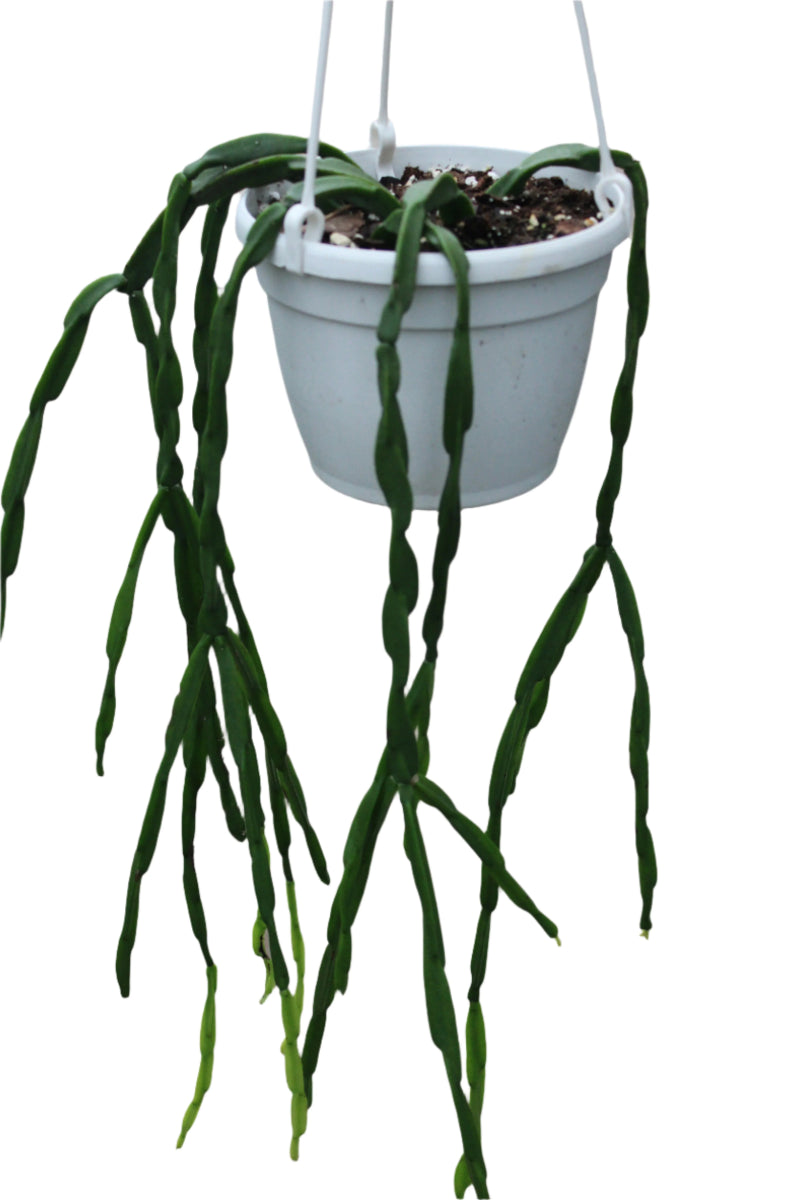
hanging cactus plant Rhipsalis paradoxa – Chain Cactus Hanging Basket
SKU: 36348905530
hanging cactus plant

hanging cactus plant Rhipsalis paradoxa – Chain Cactus Hanging Basket

Sale price$18.21 Regular price$20.23
Save 10%

Shipping Estimate
USA
  • USA
  • CAN

Ships within 48 hours · Estimated delivery Jul 7 - Jul 12

Promo Codes Available:

For Your Every Summer RSVP, with Code: SUMMER15

Description

hanging cactus plant Rhipsalis paradoxa – Chain Cactus Hanging BasketRhipsalis paradoxa Chain Cactus Hanging Basket Rhipsalis paradoxa, also known as the Chain Cactus, is a fascinating jungle cactus with long, segmented stems that resemble links in a chain. Native to the humid forests of Brazil, this epiphytic cactus naturally grows on tree branches, where its stems drape gracefully in filtered light. In a hanging basket, those same pendulous chains create an eye catching, architectural display that feels sculptural

Rhipsalis paradoxa – Chain Cactus Hanging Basket

Rhipsalis paradoxa, also known as the Chain Cactus, is a fascinating jungle cactus with long, segmented stems that resemble links in a chain. Native to the humid forests of Brazil, this epiphytic cactus naturally grows on tree branches, where its stems drape gracefully in filtered light. In a hanging basket, those same pendulous chains create an eye-catching, architectural display that feels sculptural and soft at the same time.

Unlike typical desert cacti, Rhipsalis enjoys gentle light, consistent moisture, and higher humidity—making it a perfect plant for bright rooms, plant shelves, and hanging corners that don’t get harsh direct sun.


Plant Profile

  • Botanical Name: Rhipsalis paradoxa
  • Common Names: Chain Cactus, Link Cactus
  • Family: Cactaceae
  • Native Range: Atlantic forests of Brazil (subtropical/tropical moist lowland forests)
  • Plant Type: Epiphytic, jungle cactus with trailing segmented stems

Rhipsalis Paradoxa Care Guide

  • Care Level: Easy to Moderate – forgiving once you match its jungle-cactus needs
  • Light: Bright, indirect light is ideal. It also does well in dappled or medium light. Avoid harsh, direct sun that can scorch the stems.
  • Water: Keep the soil lightly moist but never soggy. Water thoroughly, then allow the top 1–2 inches of soil to dry out before watering again. Reduce watering slightly in winter.
  • Humidity: Prefers moderate to high humidity (around 50–70%). Typical household humidity is fine, but added humidity will encourage lush growth.
  • Temperature: Best between 60–80°F. Protect from cold drafts and avoid temperatures below ~50°F.
  • Soil: Use a very well-draining, airy mix (such as cactus or succulent mix amended with orchid bark and perlite) to mimic its epiphytic roots.
  • Feeding: Fertilize monthly during spring and summer with a diluted, balanced or cactus-specific liquid fertilizer.
  • Growth Habit: Trailing; chain-like segmented stems can easily reach 2–3+ feet in length in a hanging basket.
  • Pruning: Trim stems to control length or shape; cut segments can be used for propagation.
  • Propagation: Simple from stem cuttings—allow cut ends to callus briefly, then plant in a well-draining mix.
  • Toxicity: Considered non-toxic to humans and pets if touched or ingested.

What Makes Rhipsalis Paradoxa Unique?

This isn’t your typical spiky cactus. Rhipsalis paradoxa is thornless, soft to the touch, and naturally cascading. The stems are made of plump, three-angled segments that link together like a chain, creating a sculptural, almost geometric look in a hanging basket. In the right conditions, small white flowers can appear along the stems, followed by decorative berry-like fruits—an extra reward for consistent care.

Because it’s epiphytic and adapted to life in the tree canopy, it tolerates gentler light and appreciates humidity more than desert cacti do. That makes it a great choice for bright rooms, near east- or north-facing windows, or a bit back from a sunny window where the light is filtered.


Styling Your Chain Cactus

Hang your Rhipsalis paradoxa where its cascading stems can really shine—over a stairwell, in front of a bright window, or as a statement piece in your plant corner. Pair it with broad-leafed foliage plants for contrast, or group it with other epiphytic cacti for a lush, jungle-inspired look.

Pro Tip: Rotate the hanging basket every few weeks so the stems grow evenly and form a full, balanced cascade.

Shipping Notes
  • Free Standard Shipping on $100+ Orders to the USA.
  • Except Preorder products are shipped in 48 hours.
  • Delivery to the USA:
  1. Standard Shipping : 3-10 business days
  • If time is of the essence, please consider selecting expedited delivery for faster service.
Exchange/Return Notes
  • We offer a 30-day return/exchange service after receiving.
  • Final sale items are not eligible for returns or exchanges.
  • To process your return/exchange, please contact us at [email protected]
  • Please click here for more details>>> Return & Exchange Policy
SKU: 36348905530

Discover Niche Categories That Outsell hanging cactus plant

Top-Converting Item to Boost Your Average Order

4.6 ★★★★★
Based on 2041 reviews
Sort
Highest Rating
Newest First
Oldest First
Product Reviews
A
Verified Purchase
Amazon Customer
Pawtucket, US
★★★★★ 5
Engaging & Effective for toddlers w/Autism!
Format: Paperback, Format: Paperback
My almost 3 year old was recently diagnosed with Autism. He struggles with transitions and also has a speech delay, which often contributes to big meltdowns when he doesn’t get his way. He’s been a “hitter” since about 18M… and it’s so hard! I know he has big emotions and can’t regulate them easily. This book is FANTASTIC! It’s easy to read and has cute and relatable illustrations. It can be a little repetitive, but that’s what helps get the point across. Let’s face it, my son is also very repetitive, so it seems to resonate with him. It talks about different feelings and emotions, how it’s ok to feel that way, and how to handle them without hitting. For example, you can use your words to ask a grownup for help; you can draw an angry picture; you can squeeze your hands into a ball and release them, etc. There’s different options for different scenarios, and each one is described in a way that toddlers can figure out how to do it themselves. His favorite is to squeeze his hands into a fist, or give his body a big “squeeze hug.” I’ve already caught him doing that a few times instead of slapping me! It’ll take practice (like the book mentions) but I think he’ll be able to self-regulate better with some of these ideas!! I also have some new phrases to use and picked up some sign language. I love the tips for caregivers in the back! If you have a hitter (especially one on the spectrum), you need this! I actually like it better than our other book, Hands Are Not for Hitting. Similar story line, but this one is more detailed and better suited for older toddlers. I highly recommend it!! Hope this helps ☺️
WAS THIS REVIEW HELPFUL?YesReportShare
Reviewed in the United States on March 14, 2022
E
Verified Purchase
eDUB
Bozeman, US
★★★★★ 5
Wonderful Book for Toddlers and Up!
Format: Paperback, Format: Paperback
Great book for toddlers or older! I bought this for my 2.5 y.o. and she would request me to read it every night. She would demonstrate some of the techniques described in the book at her own voilition, which was awesome because it showed that a couple methods were 'sticking.' The next step was trying to help her to perform the technique when needed....like when wanting to hit her brother, which is a bit more challenging! The illustrations are beautiful, large, and colorful. There's one sentence that I think is confusing for little ones to comprehend, such as the breathing method you'd use when blowing bubbles or a pinwheel. I wish there was an "as if" in there so it's taken less literally. However, the flow of the book is nice. It goes through situations which might occur, how you might feel, and then the techniques. Love the page that summarizes all the techniques and the 6 strategies in the back for parents. The pages are a slightly thicker than most paperbacks for kids - more durable for sure, which I appreciate. It's written by a child psychologist, so you know it's going to be a book of quality!
WAS THIS REVIEW HELPFUL?YesReportShare
Reviewed in the United States on January 23, 2025
J
Verified Purchase
James Roberts
Belleville, US
★★★★★ 5
Well done
Format: Hardcover
Beautiful book. Big, beautiful illustrations. The reading is easy though some of the concepts may be a little difficult for younger ones to grasp. Though this just leaves a great opportunity for further discussion on all the different reasons for crying. Great teaching tool. The illustrations do a wonderful job depicting these deeper concepts. Readers may find themselves lingering a little bit on each page, after the reading is done, absorbing the meaning of the words and pictures. Very well done.
WAS THIS REVIEW HELPFUL?YesReportShare
Reviewed in the United States on May 17, 2020
S
Verified Purchase
SacDancer
Massapequa, US
★★★★★ 5
Beautiful book, sweet message
Format: Hardcover
Go ahead and buy it for all the kids you know
WAS THIS REVIEW HELPFUL?YesReportShare
Reviewed in the United States on December 11, 2021
A
AnnieB
Lake Worth, US
★★★★★ 5
Sensitively written and beautifully illustrated
Format: Hardcover
Why Do We Cry? is an sweetly illustrated and sensitively written book for young readers. Originally published in Spanish in 2018, this English translation released 7th April 2020 from Kids Can Press is 34 pages and available in hardcover and ebook formats. The book takes the form of a dialogue between a mother and son about why people cry and why it's good to examine and experience negative emotions so we can process them and what function tears (and crying) actually serve physiologically and emotionally. The text by Fran Pintadera (weblink in Spanish) is supported and enhanced beautifully by the nuanced illustrations by Ana Sender. This would make a superlative reading circle, library group, or classroom read for youngsters. There's a short discussion resource at the back of the book which includes some science based information on tears and the physiological functions they perform. Learning to process strong emotion in a positive and constructive manner is -vital- for development. I appreciated that the dialogue was sensitively handled and that the author chose to make the child male was a nice touch. I think that this could be a very valuable book *especially* given our current pandemic world situation. Five stars. Beautiful little book with universal relevance. Disclosure: I received an ARC at no cost from the author/publisher for review purposes.
WAS THIS REVIEW HELPFUL?YesReportShare
Reviewed in the United States on April 19, 2020

recommand products